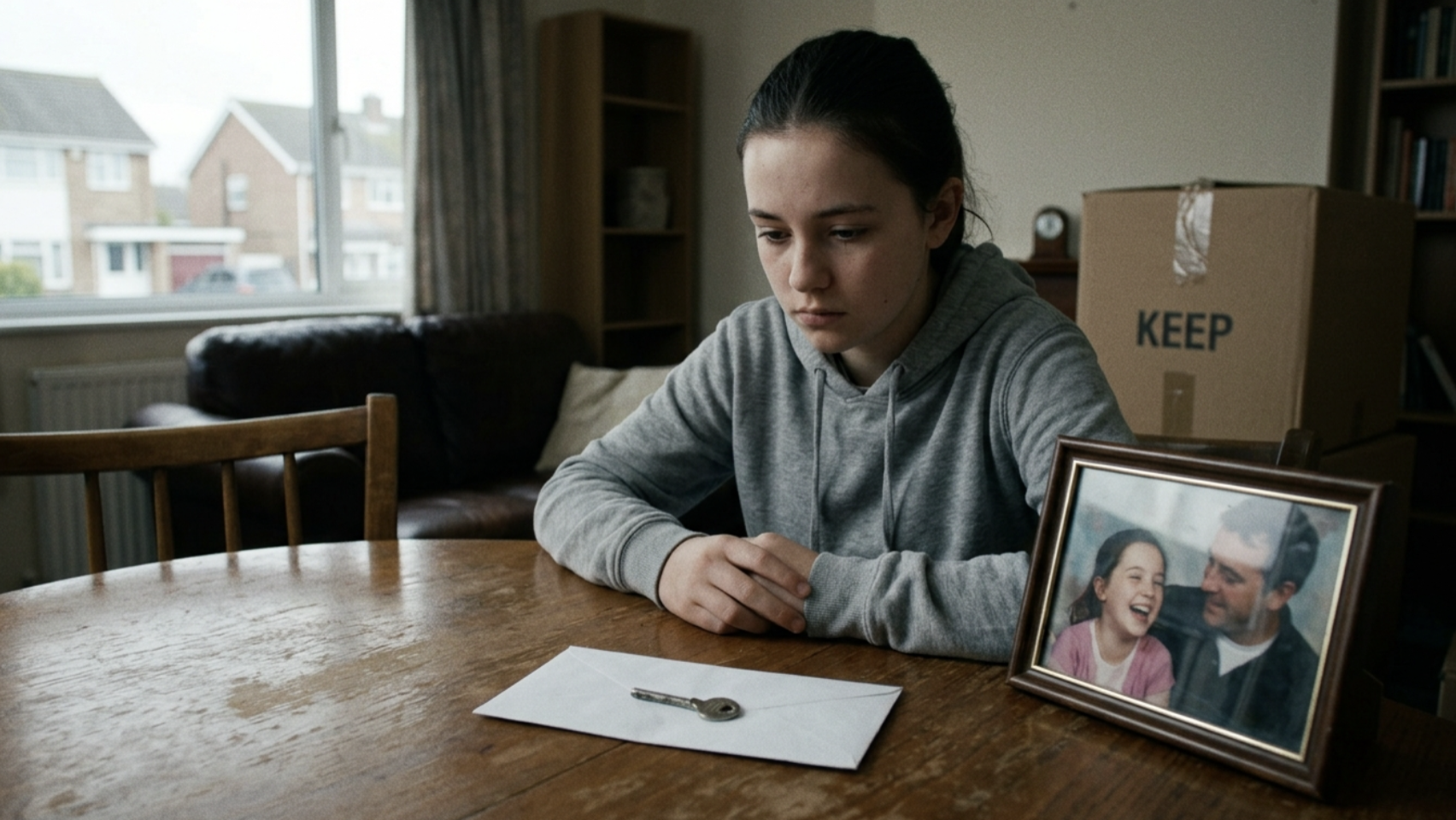
“She requested that if you ever accessed the box, we should give you this.”
The employee handed her another envelope.
Rebecca stared at it.
Her name was written in her mother’s handwriting.
She opened it.
Inside was a single piece of paper.
“Rebecca, if you reached this point, don’t come looking for me because you feel guilty. Come only if you want to know me as your mother—not as your bank account, emergency contact, babysitter, or rescuer.”
Rebecca’s eyes filled again.
“I have spent my whole life trying to make sure you never experienced hardship. Perhaps that was my mistake. Sometimes love means helping. Sometimes love means stepping back.”
At the bottom was one final sentence.
“I will not chase you anymore. If you want me in your life, you will have to walk toward me.”
Rebecca folded the letter.
This time, she didn’t cry.
She simply sat there, thinking.
Then she made a decision.
She wasn’t going to call her mother.
Not yet.
She was going to fix something first.
She drove home and sat down with Daniel.
“We need to refinance the house.”
Daniel looked surprised.
“With what money?”
“I’ll get another job.”
“You already work full-time.”
“Then I’ll work more.”
Daniel stared at her.
“Rebecca, this isn’t just about the mortgage, is it?”
“No.”
She looked at him.
“It isn’t about Mom’s money anymore.”
“What is it about?”
Rebecca swallowed.
“I don’t know who I am without her doing everything for me.”
Daniel said nothing.
That was the first honest thing Rebecca had admitted.
Over the next several weeks, Rebecca’s life changed.
She cut unnecessary expenses.
Sold a second car.
Canceled subscriptions.
Stopped eating out.
She found freelance work at night.
Daniel took extra shifts.
The twins noticed their parents were stressed.
One evening, the older twin asked, “Mommy, is Grandma coming for dinner?”
Rebecca froze.
“No.”
“Why?”
Rebecca looked at her child.
Because there was no simple answer.
“She needed some time away.”
“Did we do something wrong?”
Rebecca’s heart broke.
“No, sweetheart.”
She hugged her child.
“Grandma loves you very much.”
The little girl looked at her.
“Then why doesn’t she call?”
Rebecca closed her eyes.
Because she had told her mother not to.
“I think,” Rebecca whispered, “Grandma is waiting for us to call her.”
The next morning, Rebecca bought a plane ticket.
Not for herself.
For her children.
Then she canceled it.
She realized she was still thinking the old way.
If I go, Mom will fix everything.
No.
That wasn’t what Julieta wanted.
Rebecca needed to approach her mother differently.
So she wrote a letter.
Not a text.
Not an email.
A real letter.
She wrote for three pages.
Then tore them up.
She started again.
This time, she didn’t explain.
She didn’t defend herself.
She didn’t mention money.
She simply wrote:
Mom,
I was cruel to you.
You didn’t deserve what I said.
I spent years believing your help meant you wanted control over me. I never stopped to ask whether you were helping because you loved me.
I understand now.
I also understand that saying sorry doesn’t erase what I did.
I’m not asking you to come home.
I’m not asking you to pay anything.
I’m not asking you to rescue me.
I only want the chance to become someone you can love without having to save.
If you never want to speak to me again, I will respect that.
But if there is even a small part of you that wants a relationship with me again, I’ll be here.
I love you.
Rebecca.
She mailed the letter.
Then she waited.
A week passed.
Nothing.
Two weeks.
Nothing.
Three weeks.
Nothing.
Rebecca tried not to panic.
She kept working.
She kept paying the bills.
She learned how to manage the household finances herself.
For the first time, she knew exactly what the mortgage cost.
Exactly what the utilities cost.
Exactly what the insurance cost.
Exactly what it took to keep the family running.
And slowly, something unexpected happened.
She became proud of herself.
Not because she was wealthy.
Not because she had everything.
But because she had stopped waiting for someone else to solve her problems.
Then, on a cold Saturday morning, the twins ran into the kitchen.
“Mom!”
Rebecca turned.
“What?”
“There’s a package!”
Rebecca walked to the front door.
A small box sat on the porch.
There was no return address.
Her hands trembled before she even opened it.
Inside was a photograph.
Rebecca at age six.
She was sitting on Julieta’s shoulders at a county fair.
Behind the photograph was a note.
“I still have the same picture.”
Rebecca covered her mouth.
There was another note.
“If you still want to talk, call this number.”
Underneath was a Swiss phone number.
Rebecca stared at it.
She didn’t call immediately.
She walked outside.
Sat on the porch.
Looked at the photograph.
Then she dialed.
One ring.
Two.
Three.
A voice answered.
“Hello?”
Rebecca couldn’t speak.
The voice on the other end was older than she remembered.
Softer.
But it was unmistakably her mother.
“Mom?”
Silence.
Then:
“Yes.”
Rebecca started crying.
“I’m sorry.”
Julieta didn’t respond immediately.
Rebecca continued.
“I know sorry isn’t enough.”
“No,” Julieta said gently. “It isn’t.”
Rebecca nodded even though her mother couldn’t see her.
“I know.”
Another silence.
Then Julieta asked:
“How are the children?”
Rebecca laughed through her tears.
“They miss you.”
“I miss them too.”
Rebecca looked at the photograph.
“They ask about you every day.”
“I think about them every day.”
Rebecca took a deep breath.
“Mom, can I come see you?”
Julieta was quiet.
“Why?”
Rebecca had expected the question.
She answered honestly.
“Not because I need money.”
Silence.
“Not because I need you to fix the house.”
Another silence.
“Not because I want you to come home and start doing everything again.”
Her voice cracked.
“I just want my mother.”
On the other end of the phone, Julieta began to cry.
Rebecca had never heard her mother cry like that.
Finally, Julieta said:
“Then come.”
Rebecca closed her eyes.
“But Rebecca?”
“Yes?”
“Come as my daughter.”
“I will.”
“Not as someone looking for a solution.”
Rebecca smiled through her tears.
“I promise.”
Three weeks later, Rebecca arrived in Switzerland with the twins.
Julieta stood outside the small apartment.
She wore a simple gray coat.
Her hair was shorter.
She looked healthier.
Peaceful.
For a moment, nobody moved.
Then the twins ran toward her.
“Grandma!”
Julieta dropped her bag.
She knelt.
The children wrapped their arms around her.
And Julieta held them tightly.
Rebecca stood several feet away.
She wasn’t sure what to do.
Julieta looked at her.
Rebecca whispered:
“Hi, Mom.”
Julieta smiled.
“Hi, sweetheart.”
Rebecca began crying.
Julieta opened her arms.
Rebecca stepped forward.
They hugged.
It wasn’t the kind of hug that erased everything.
It wasn’t magical.
The hurt didn’t disappear.
The past didn’t change.
But something new began.
Something healthier.
Something honest.
They spent the next week walking around the city.
Rebecca learned things about her mother she had never bothered to ask.
What music she liked.
What books she read.
What foods she missed.
What she had dreamed about before becoming a mother.
And Julieta learned things about Rebecca too.
Not as a child.
As an adult.
They talked.
Sometimes they laughed.
Sometimes they became quiet.
Once, Rebecca asked the question she had been afraid to ask.
“Do you regret helping me?”
Julieta looked at the lake.
“No.”
Rebecca looked surprised.
“Really?”
“No.”
“Then what do you regret?”
Julieta thought for a moment.
“I regret teaching you that love means someone else should carry your burdens.”
Rebecca looked down.
“I thought you were controlling me.”
“I know.”
“Why didn’t you tell me?”
Julieta smiled sadly.
“Because I was afraid that if I stopped helping, you would stop loving me.”
Rebecca’s eyes filled with tears.
“Mom…”
Julieta reached for her hand.
“And now I know better.”
They sat together in silence.
Then Rebecca said:
“I don’t want to lose you again.”
“You won’t.”
“Promise?”
Julieta smiled.
“I’ll be your mother.”
Rebecca smiled.
“But not your bank.”
Julieta laughed.
“Exactly.”
Months later, Rebecca managed to bring the mortgage current.
She didn’t sell the house.
She didn’t lose it.
She simply learned how to live within her means.
She also changed something else.
She started putting money into a savings account every month.
Not for emergencies her mother would handle.
For herself.
For her children.
For their future.
The twins began video-calling Julieta every Sunday.
Sometimes Julieta answered wearing pajamas.
Sometimes she was cooking.
Sometimes she was walking beside the lake.
And sometimes she didn’t answer.
Because she was busy living.
At first, Rebecca found that strange.
Then she realized it was healthy.
Her mother had finally built a life that didn’t revolve around everyone else’s needs.
And Rebecca had finally learned to respect it.
A year after Julieta left America, Rebecca celebrated her birthday.
This time, she didn’t expect her mother to come.
She didn’t expect a gift.
She didn’t even know if Julieta would call.
At dinner, Rebecca’s phone rang.
It was Julieta.
Rebecca smiled.
“Hi, Mom.”
“Happy birthday.”
“Thank you.”
Julieta paused.
“I sent you something.”
Rebecca laughed.
“Another mysterious box?”
“Maybe.”
The package arrived the next morning.
Rebecca opened it.
Inside was a small brass key.
The same kind as the one Julieta had left on the dining table.
Rebecca stared at it.
There was a note.
“This time, it’s not the key to a safe-deposit box.”
Rebecca turned the key over.
A tiny label was attached.
HOME.
She called her mother immediately.
“What does this mean?”
Julieta laughed.
“It means I bought a little cottage near the lake.”
Rebecca smiled.
“For you?”
“For me.”
Rebecca laughed.
“Good.”
“And there is a guest room.”
Rebecca’s smile grew.
“For us?”
“For whoever wants to visit.”
Rebecca looked at the key again.
Then she understood.
Her mother wasn’t asking her to move in.
She wasn’t offering money.
She wasn’t rescuing her.
She was simply opening a door.
A door Rebecca could choose to walk through.
And that was the greatest gift of all.
Years later, Rebecca would still remember the day her mother disappeared.
People sometimes asked her why she had let things go that far.
She never had a simple answer.
But whenever someone asked what finally changed her relationship with her mother, Rebecca always told them the same thing.
“It wasn’t the money.”
“It wasn’t the mortgage.”
“It wasn’t even Switzerland.”
“It was a little brass key.”
Then she would smile sadly.
“My mother didn’t use it to lock me out.”
“She used it to show me that love could have a door.”
“And for the first time in my life, she let me decide whether I wanted to walk through it.”
Julieta never returned to being the mother who fixed everything.
And Rebecca never asked her to.
Instead, they became something better.
Mother and daughter.
Two adults.
Two people who could say no.
Two people who could say yes.
Two people who finally understood that love was not measured by how much one person could sacrifice.
It was measured by whether both people could choose each other freely.
And on quiet Sunday mornings, when Julieta looked across Lake Geneva and saw the sunlight moving across the water, she sometimes thought about the birthday when Rebecca told her to disappear.
For a long time, she had believed that sentence broke their family.
Now she knew it had done something else.
It had forced them to rebuild it.
Not on money.
Not on guilt.
Not on obligation.
But on choice.
And Julieta finally understood something she wished she had learned forty years earlier:
Sometimes walking away isn’t abandoning the people you love.
Sometimes walking away is the only way to give them the chance to learn how to stand.
And sometimes, when they finally learn to stand on their own…
They come back.
Not because they need you.
But because they love you.
One Comment on “( END) PART 4: The employee handed her another envelope”